Director of David Lynch Graduate School of Cinematic Arts at Maharishi University in Fairfield Iowa
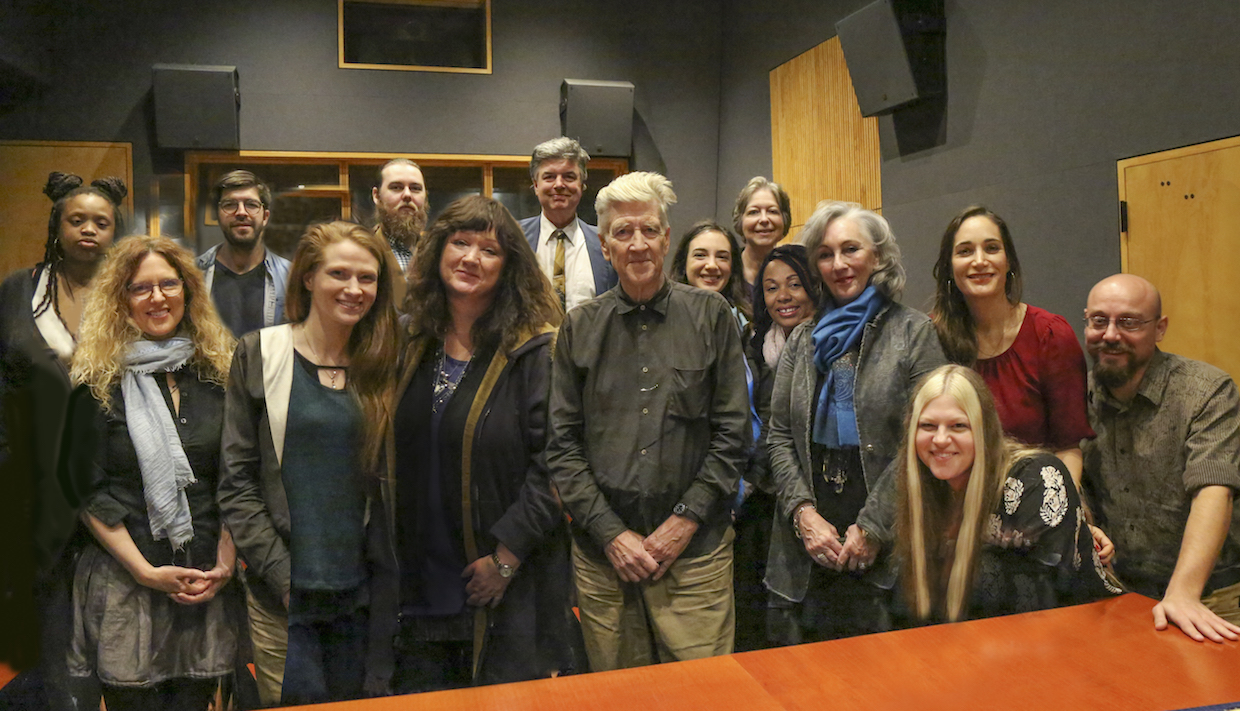 Recent graduates of the David Lynch MFA in Screenwriting Program with David Lynch at his studio in Los Angele, December 2018 (Photo past Juliet Jarmosco)
"I prefer placing the perceptual, intuitive, emotional and spiritual growth of the student at the center."
That's the succinct education argument of Pablo Frasconi, a soft-spoken, thoroughly grounded filmmaker and faculty colleague of mine in the School of Cinematic Arts at the University of Southern California. He has adult a 3-class sequence that helps students engage in a form of creativity based on quieting the mind.
"Mindfulness and meditation are central," Frasconi explains. "It is where these classes begin: past looking inward to discover the 'moving visual thinking' and 'song of the cells'—as Stan Brakhage called these experiences—that is our life energy in its purest, most vibrant form."
Frasconi is one of a group of professors interested in approaching moving-picture show production and screenwriting not from a craft-based, industry perspective but with the individual imagination and creativity of the student at the middle. With this focus on the individual artist comes the need to attend to a host of attributes useful in creativity, such as mindfulness and meditation.
Frasconi says, "I find it most constructive to nurture exploration and creativity by moving away from linear processes. Those methods are guided by divisions of labor that follow the crafts, guilds and amateur systems that governed the arts for centuries." He continues, "The new age of media is more holistic and integrated. This means that we can focus our teaching on ideas over craft." Students in his classes look inwards for subject area thing. They explore relationships and collaborations with one another, and only then practice they begin to wait out to the world.
Shayna Connelly, an associate professor in the cinema production program in the School of Cinematic Arts at DePaul Academy, uses mindfulness and meditation with her students and fifty-fifty created a class, "Creative Methodologies in Film and Idiot box," that puts meditation at its center.
"I have seen a huge uptick in anxiety amid our students," Connelly says. "I teach pic production, and anxiety kept actualization as subject matter." To assistance students deal with this angst, Connelly's methodologies grade includes breathing and meditation techniques that are explained and good in grade. She also bug assignments designed to help students continue this practice on a daily footing.
What kind of breathing techniques? "Breathe in to the count of half dozen through the nose," explains Connelly, "then count to eight while animate out through the oral cavity. The of import affair is the exhale—it is the exhale that calms the person and restructures the encephalon. If you do this for even two or iii minutes, you can experience yourself relax, and your encephalon begins to articulate."
Connelly notes that the other practices she introduces can be quite simple. "I teach observation skills. I assign a walk and ask students to be aware of the globe. I assign social media breaks. I ask students to give up a vice for a week—for some, it's Instagram; for others, information technology's chocolate. I tell them to become lost on purpose: Go out without a goal and actually wander. I encourage students to make a quick video and photograph every day." Connelly says that these practices become ritualized. "All of this is about forming a addiction, and that habit tin be a kind of meditation too, freeing the mind and reducing decisions so that you're but nowadays in the moment. When you're nowadays in the moment you encounter more, and when you see more y'all tin record more."
How else can meditation help film students? "On fix, it'southward not uncommon to take 16- to 18-hour days," says Jeremy Warner, an assistant professor in the digital media program at California State University, Bakersfield, whose didactics has engaged in a full assortment of mindfulness practices beyond theater, film and digital media. "You see the wear and tear on people with this constant stress and little balance, and meditation makes you ameliorate at treatment all of the issues that come up at you."
Warner also believes that meditation provides an excellent tool for thinking about emerging media forms. Recalling a recent lecture by VRLA cofounder Cosmo Scharf on VR, Warner expands on the theme of expanded consciousness and notes that VR and XR (expanded reality) require makers to consider notions of presence, empathy and space. Furthermore, a great VR experience demands a sense of total immersion. "With VR, you are consumed by the projection, and so information technology's a whole different way of experiencing entertainment," Warner says. As a effect, skills for getting into that country of mind on your ain may be a prerequisite.
Connelly argues that directors demand mindfulness and meditation practise if they want to connect well with their actors. "Actors are rushing from their day jobs, worrying nearly their bills, wondering if they're going to go the office, but they take to go into a room and be fully nowadays in the moment." She continues, "The beginning matter they learn to do is to relax. Directors need to do this as well. The best way for a managing director to connect with an player is to be placidity and fully present in the moment—merely we don't teach students to exercise this."
Faculty actually practice teach students to do this at the David Lynch Graduate Schoolhouse of Cinematic Arts at the Maharishi University of Direction in Fairfield, Iowa, where the 2-year MFA program in screenwriting is thriving based on its full integration of Transcendental Meditation (TM) and storytelling. Everyone—students, faculty and staff—at the university engages in TM, and the upshot is a unique learning environment and a compelling program for screenwriters.
"The entire concept of this writing program is that nosotros apply TM to connect the creative person to the inner wealth of stories, so that they tin be an authentic storyteller," explains the program's creator and director Dorothy Rompalske. "The students in the screenwriting programme are as interested in their spiritual growth as they are in their writing ability."
The depression-residency plan begins on campus with a 10-solar day session, during which students larn the concepts and practise of TM and meditate in class together at the beginning of each mean solar day and again in the afternoon. "This has a profound result of connecting everyone in the room," explains Rompalske, who adds that the integration of meditation into the plan achieves three things: "Practicing the TM technique allows us to settle down and access the ideas and stories we all have inside us. Students observe that they tin can explore ideas that may be painful or difficult. These may have been difficult to explore before, and the meditation is important in diminishing stress. The students are also very supportive of each other, and they listen to each other deeply."
WThe programme is inspired past David Lynch, who discusses meditation practise in his volume Communicable the Large Fish: Meditation, Consciousness and Creativity. Lynch describes accessing "an ocean of pure consciousness, pure knowingness" and attributes his own artistic practice, sense of intuition and feelings of joy and pleasure specifically to his 20-minute meditations each morn and afternoon.
Students in Rompalske'southward program report Lynch's work and enjoy unique admission to some of his materials; they besides speak with him during course sessions. Concluding semester, the graduating cohort visited his LA-based studio during a trip designed to assistance students make the transition from the program into the manufacture.
Rompalske notes that the low-residency nature of the screenwriting program works well. Each of the ten-day sessions is a rigorous mix of lectures, panel discussions, writing workshops, screenings and master classes with expert guests, but meditation and a focus on spirituality also play an important function. Indeed, many students who might struggle to live in a small town year circular appreciate coming to quiet Fairfield. "Coming hither becomes a retreat," says Rompalske.
In addition to their synchronous online class sessions and residencies, each student as well has an industry mentor, with whom they speak weekly. So far, the screenwriting program, which launched in 2016, has been very successful, and the schoolhouse is experimenting too with models for a product programme and international plan in China for Chinese filmmakers.
Lynch probably doesn't have many detractors at his university, simply faculty elsewhere are not and so sheltered. "When I started pedagogy meditation practices, guided visualizations and mindfulness at USC in my classes—well-nigh twenty years ago—information technology was thought to be flaky, marginal or fringe," says Frasconi, who adds that students now tend to be more than familiar with mindfulness and ready for exploration.
Rompalske shrugs off any cynicism she encounters, pointing to the enthusiasm of her students for their unique program. "Nosotros are interested in helping creative people tell authentic stories, and nosotros are very well aware of the trends in the manufacture—there is clearly a shift starting to happen toward more accurate storytelling."
Source: https://filmmakermagazine.com/107128-breathe-deep/
0 Response to "Director of David Lynch Graduate School of Cinematic Arts at Maharishi University in Fairfield Iowa"
Post a Comment