Realistic Drawings Bodys Guys With Girls Being Intimate
'Disarmingly intimate' photos of women
(Paradigm credit:
Susan Meiselas / Magnum Photos
)
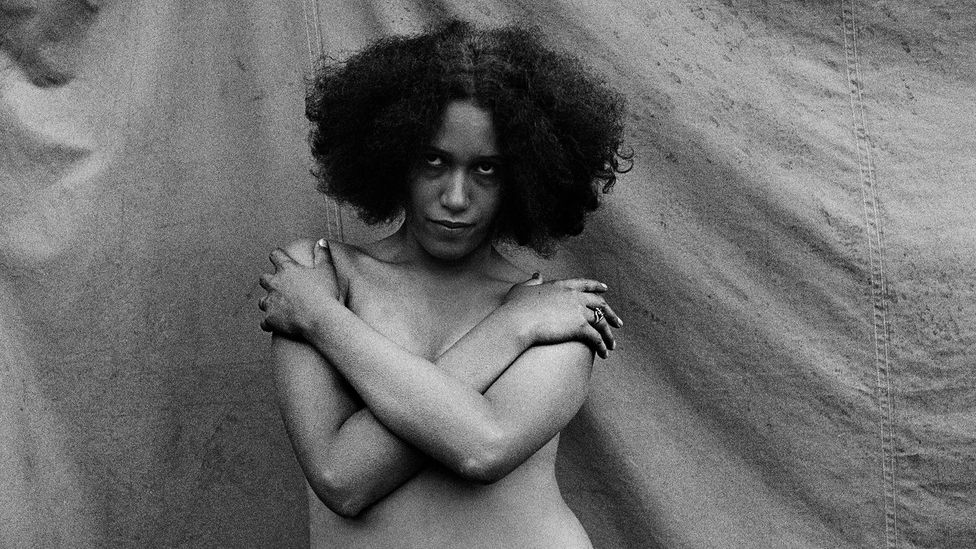
An exhibition at the Rencontres d'Arles festival features work by three female photographers who each capture revealing and rarely seen images of women.
T
The The states lensman Susan Meiselas first began shooting women who took their clothes off for a living in 1972, when she was in her mid-20s. Travelling effectually New England, she'd encountered the land fairs that toured rural parts of the northeastern United states of america; many had a 'girl show' tent, where women danced in striptease acts. Meiselas was fascinated. Over the form of three summers, she haunted the fairgrounds, befriending dancers and sneaking backstage to capture what their lives were actually like. She too recorded hundreds of hours of interviews. In social club to blend into the crowd and get the shots she needed, she sometimes dressed similar a man.
More like this:
- Why Cindy Sherman'southward photos are and so mysterious
- April Dawn Alison: Photos that reveal a hugger-mugger identity
- La Movida: Spain's wild party later on Fascism
The volume Meiselas somewhen produced, Funfair Strippers (1976), has become a classic. Unsparing simply sympathetic, both humane and abjectly sad, it showed a world many at the time preferred to ignore: one in which women danced nude for handfuls of dollars, in tawdry, spit-and-sawdust tents erected in one-horse towns. Nevertheless perhaps the well-nigh remarkable matter about the piece of work is that Meiselas gives the story a complicating twist. Nosotros might expect a sob story – a tale of exploited, objectified women in an exploitative, objectifying industry. Yet Meiselas finds nuance in the biographies of the women who danced, along with remarkable amounts of self-awareness and courage. Ane says that performing is her path to financial independence; some other that the carnival has given her a dwelling when she had nowhere else to go.
"Information technology was a complex story, and I wanted to testify it in its complexity," Meiselas tells BBC Civilization. "Not anybody was expecting that."
Forty-iii years later it came out, Carnival Strippers is the centrepiece of an exhibition at this twelvemonth's Rencontres d'Arles photography festival. Entitled Unretouched Women, information technology reunites Meiselas's photo essay with ii other books from the aforementioned catamenia past American female photographers, both canonical in their manner. One is the publication that gives the evidence its title, The Unretouched Woman (published the same year, 1976), in which Eve Arnold, a pioneering photojournalist, compiled portraits she had taken of women around the world over the previous quarter-century. The third is Abigail Heyman's Growing Upward Female (1974), which describes itself equally "nearly women, and their lives as women, from one feminist'southward betoken of view".
All 3 books were their authors' first: a take chances to make their own artistic selections and tell the story in their ain terms, rather than dealing with the whims of magazine picture editors (usually male). And in their different ways, all three paint a portrait of a tumultuous and convulsive era. 2nd-wave feminists were campaigning for problems such as abortion rights, workplace equality and an finish to sexual harassment; female person photographers were challenging the male gaze and questions almost how women should be represented. Four decades agone this might be, but walking through the prove, you feel you're not so much stepping into history equally peering at a mirror of the present day.
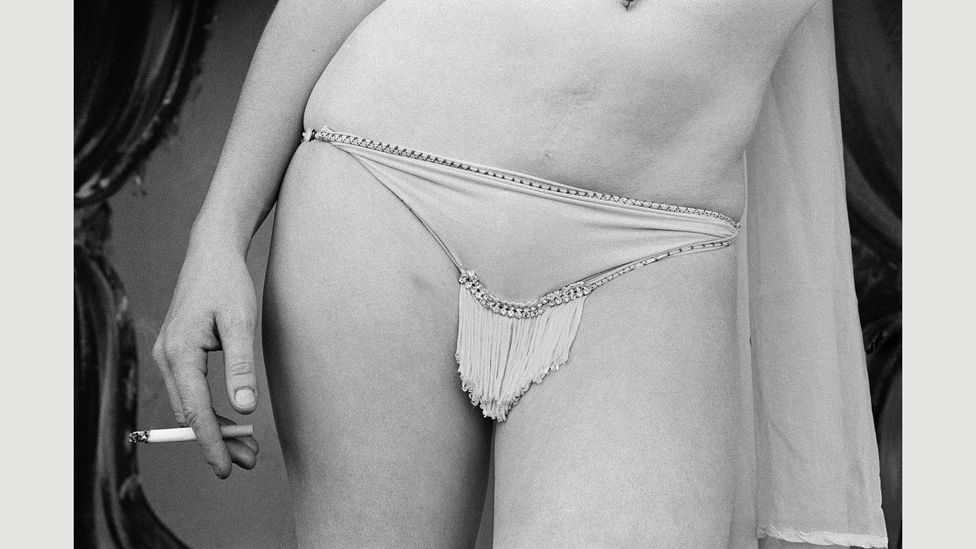
Susan Meiselas, Shortie on the Bally, Barton, Vermont, USA (Credit: Susan Meiselas / Magnum Photos)
"Back and so, these issues were only just starting to filter into photography," says the curator, Clara Bouveresse. "But when you look at them today, you realise how topical and relevant they are now."
Private moments
When Meiselas and I speak, I enquire her for her memories of the mid-70s, and how Carnival Strippers fitted into the debates of the fourth dimension. She recalls that opting to turn her lens on women who stripped felt like a controversial act: some of her fellow feminists were appalled that she was attempting to document and understand this world rather than condemn it outright.
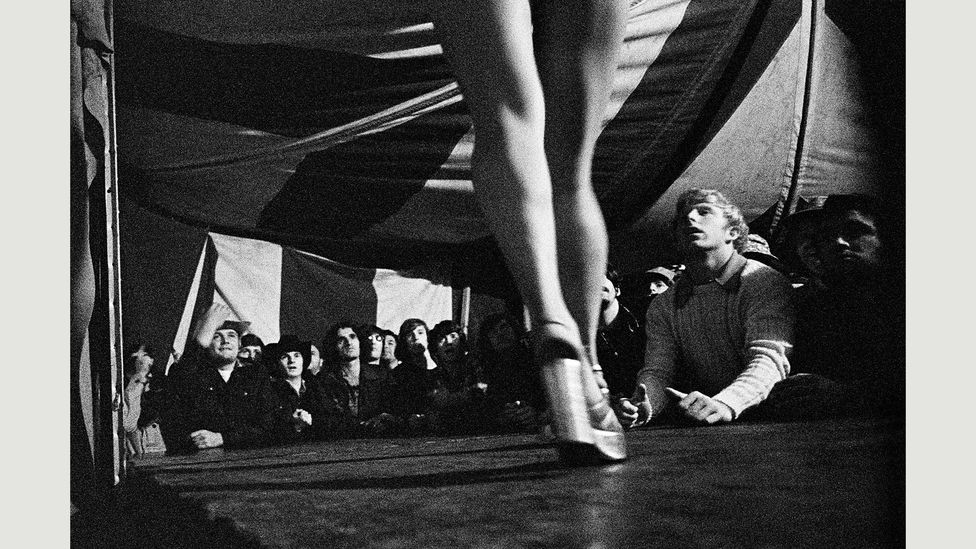
Susan Meiselas, Tunbridge, Vermont, USA, 1974 (Credit: Susan Meiselas / Magnum Photos)
"A lot of women regarded the daughter shows equally straightforwardly exploitative," she says. "That was the debate that was going on. But I wanted the volume to be office of a dialogue. When one of the women I photographed, Lena, says she constitute performing a revolutionary experience, that for the first time she'd got men eating out of her paw, who could deny her that feeling? She was acting in defiance against what the globe she'd grown up in expected her to be."
The pictures in Carnival Strippers are disarmingly intimate. Nosotros practise see the dancers in their carefully crafted public roles, gyrating on makeshift stages in tasseled bikinis or posing for mobs of gawping, baying men. I particularly uncomfortable shot shows a woman in a semi-transparent twin piece perching on the 'bally box' outside the tent to drum upwardly concern, equally if she'due south a prize animal on show.
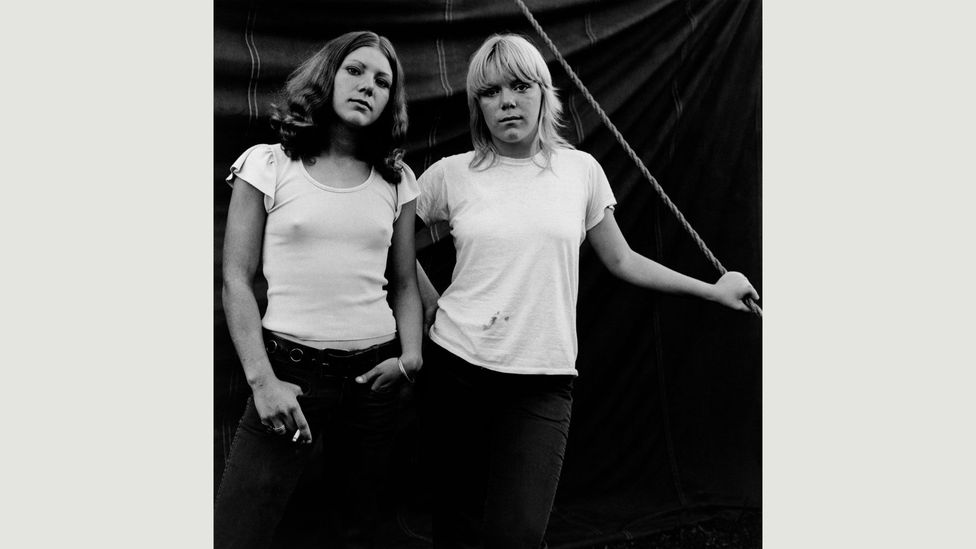
Susan Meiselas, Debbie and Renee, Rockland, Maine, USA, 1972 (Credit: Susan Meiselas / Magnum Photos)
But nosotros also glimpse the strippers in private moments: lounging in dressing rooms playing cards; horsing around; swigging beer; collapsed on motel beds. For women who spend their lives on show, these times, captured past Meiselas in grainy, low-light photographs drenched in shadow and atmosphere, must have been particularly precious. In contrast to the bodies they put on display for paying customers, artfully costumed and made up, their existent bodies – scarred, sweaty, muddy, sometimes bruised – are finally visible. It is a different and altogether more revealing kind of nakedness.
Bouveresse agrees: "In that location's an empowerment of sorts in these pictures: you lot see the multifariousness of bodies, the flesh, the pare, the pilus, the wrinkles, the scars."
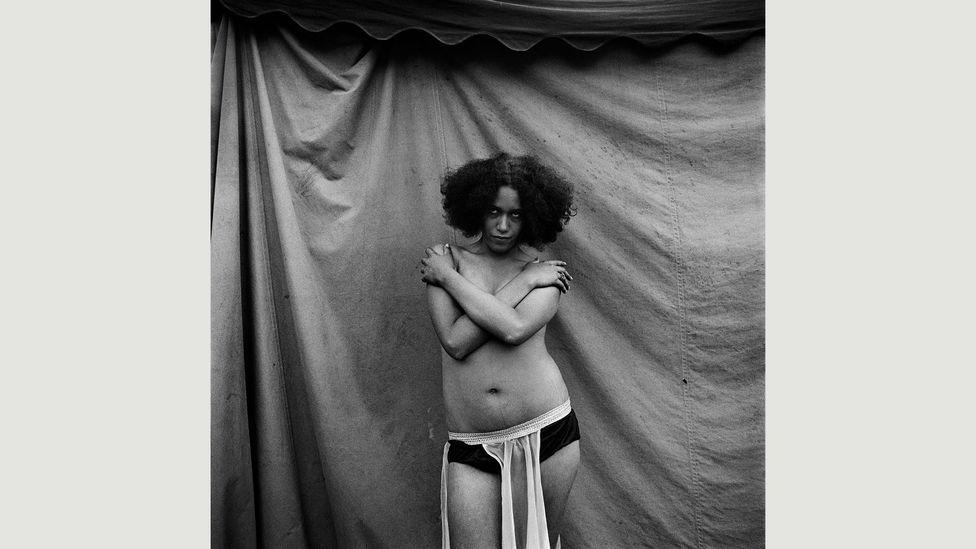
Susan Meiselas, New Girl, Tunbridge, Vermont, USA (Credit: Susan Meiselas / Magnum Photos)
Complexity is everywhere you wait. A shot of Lena undercuts – or at least complicates – her words almost revolution by depicting her after the evidence, naked and plainly exhausted, pressing a towel to her face in what looks similar agony. Yet elsewhere you lot sense something more defiant: a sense that these women are attempting to command how we look at them (Meiselas made sure to share her contact sheets with her subjects, often asking them to choose which pictures they liked). For all the tattiness of the fairs, what comes through is the sense of a shut backstage customs – solidarity, perhaps sisterhood.
Meiselas says, as a women watching these women, she felt it too. "I was like them and not like them," she says. "That's why the project was so interesting to me, in a way."
A republic of looking
Eve Arnold's pictures are revealing in a unlike sense. Born in Philadelphia in 1912, Arnold shattered nearly every drinking glass ceiling placed in her way: i of the showtime full members of the prestigious Magnum photo bureau in the late 1950s, she managed to make a career as an independent photojournalist in an era when that trade was most exclusively male (she one time observed that "it's the frustration that drives you").
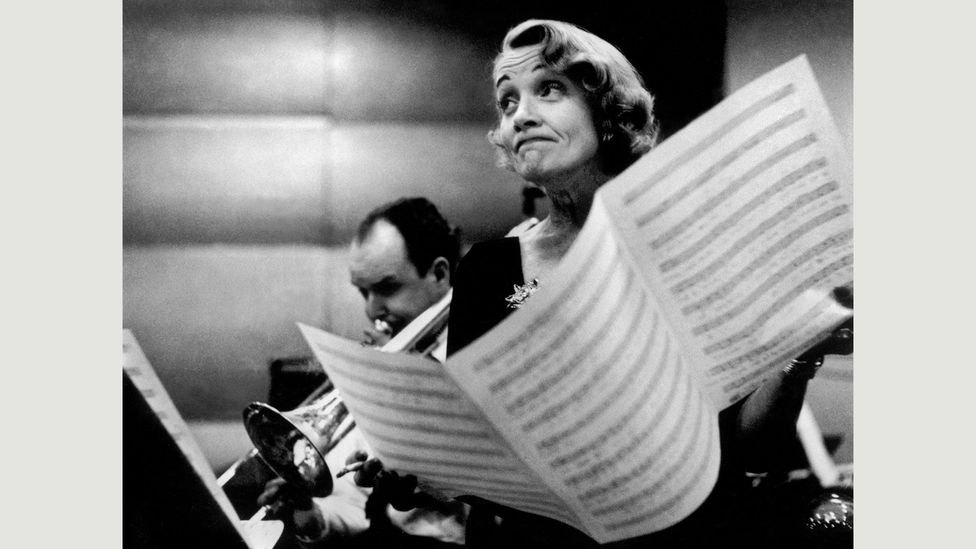
Eve Arnold, Marlene Dietrich at the Recording Studios of Columbia Records, New York, Nov 1952 (Credit: Eve Arnold / Magnum Photos)
A cocky-confessed workaholic, she had pictures printed in near every major photography publication of the 60s and 70s, amidst them the Sunday Times Magazine, Esquire, Harper'due south Bazaar, and Life magazine, and became peculiarly renowned for candid shots of celebrities such as Joan Crawford, James Dean, Andy Warhol and Paul Newman. Despite the astonishing range of her work – South African townships in the apartheid era alongside confessional portraits of Marilyn Monroe, whom she shadowed for nearly a decade – she always had an eye for female person subjects. In the early 1960s, she shot a pioneering photograph essay on nativity, and in 1971 made a pic, Women Behind the Veil, which stepped inside the closeted world of Arab hammams and harems.
However, she waited until her 60s to produce The Unretouched Woman. "It was a fashion of looking back at her career as a photographer, saying who she was," says Bouveresse.
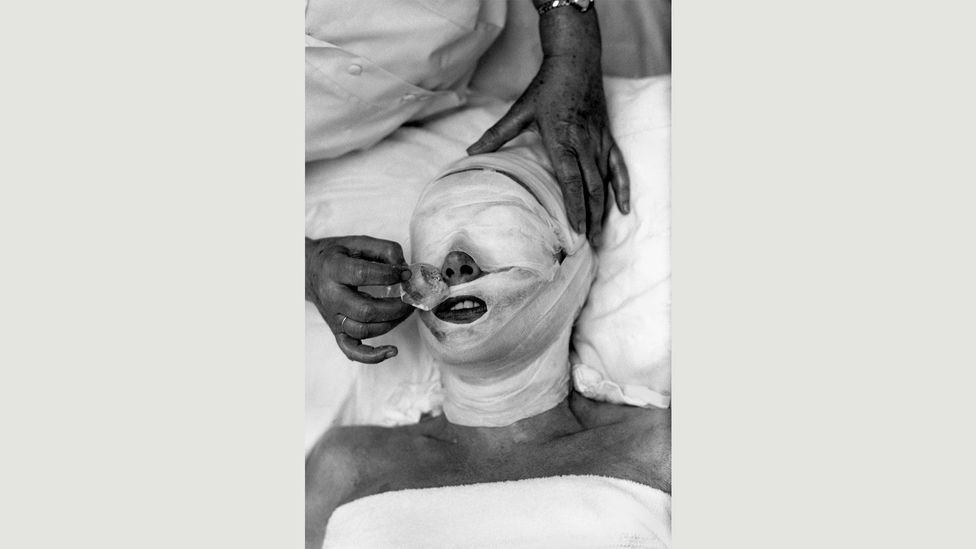
Eve Arnold, Actress Joan Crawford, Los Angeles, 1959 (Credit: Eve Arnold / Magnum Photos)
Though some of the images in the book feel a little uninvolved – pitch-perfect, pin-sharp pictures gathered past a globetrotting pro – they withal speak to the democracy of Arnold's mode of looking at the world, especially the women in it. Next to an epitome of pregnant Zulu women in a labour ward in South Africa there is a melancholy portrait of an elderly woman in a care home in the Cotswolds in England. Yes, here'south Marilyn, probably the about photographed face of her era, just there are also women from Afghanistan, their ain features obscured by flowing chadors.
Peradventure the about moving images in the Arles exhibition are those shot past Abigail Heyman. A neglected effigy now, Heyman's endeavor to capture female feel in Growing Up Female person (subtitle: A Personal Photojournal) is more inwards-looking than the other books: a living-out of the mantra that the personal is political. Combining unstaged, stripped-dorsum photographs with handwritten comments, it echoes another canonical feminist text of the era, the bestselling report of female health and sexuality, Our Bodies, Ourselves. Where that book – which included guidance on everything from sexual orientation and gender identity to birth control – encouraged women to take control of their destiny, Heyman'south images show usa, over again and again, how rarely women are portrayed in the media as they really are, fifty-fifty at present.
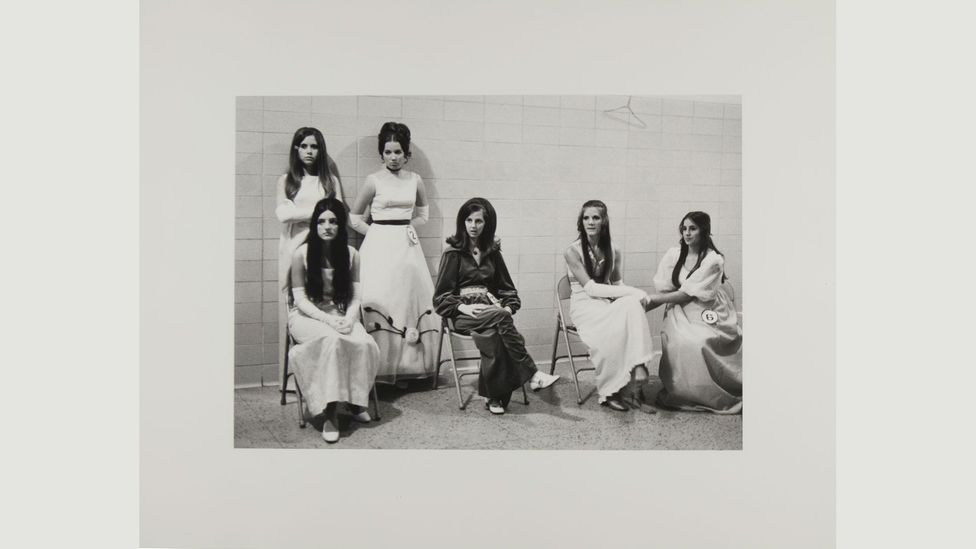
Abigail Heyman, Beauty Pageant, 1971 (Credit: Courtesy of Abigail Heyman)
As well every bit the elementary beauty of these photographs – shot in a luminous black-and-white that, in Arles, seems to spring off the walls – they're full of sly irony. 1 of Heyman'due south photographs is a group shot of a beauty pageant in the Deep South of the Usa: half-dozen teenage girls, impeccably preened and perched on folding chairs, looking bored out of their skulls by the experience – as well they might. A motion-picture show taken at the Houston Livestock Off-white in 1970 is a droll essay in gender expectations: 3 men in sober slacks and blazers clustered around a woman wearing a 10-gallon chapeau, knee joint-high boots and the shortest of shorts (one wonders what would have happened if the dress codes had been reversed).
Equally oft, though, those expectations are turned on their head. A moving picture of schoolgirls in uniform tartan skirts catches ane girl in pigtails separated from the rest of the pack: legs planted wide with a fearsome expression on her face, she stands defiantly alone, determined not to keep with the crowd.
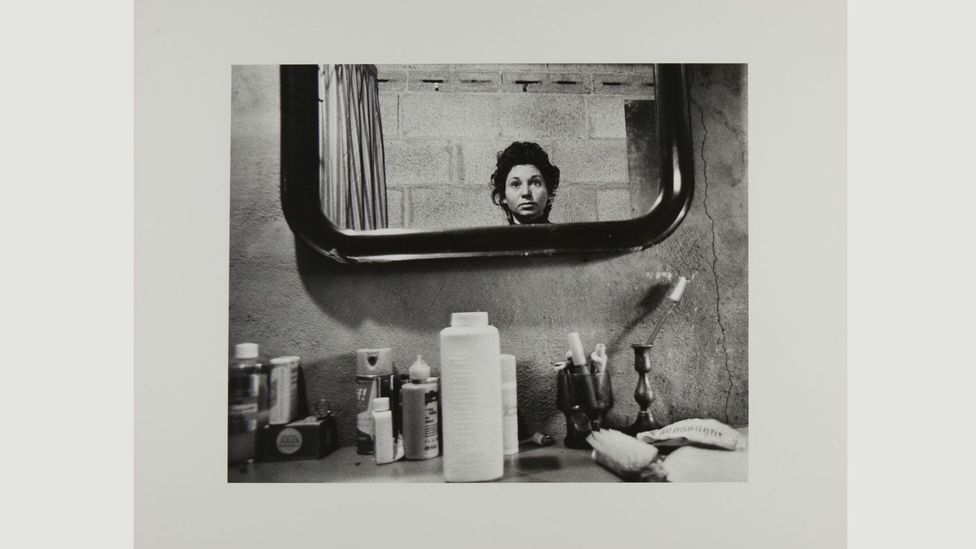
Abigail Heyman, Self-Portrait, 1971 (Credit: Courtesy of Abigail Heyman)
Somehow, it's the photographs Heyman took of herself – a feminist lensman's perspective on her own experience as a woman – that speak loudest to the exhibition's theme. I of her most reproduced images is of her own face caught in the bath mirror in an expression of surprise. Because of the angle she's taken the photograph from, her features are tiny, half cut-off by the mirror. Looming large at the bottom of the frame – far larger, in fact, than Heyman's head – are a clutter of beauty products, creams, gels and powders. Which is the more honest self-portrait, information technology seems to ask: my confront, or the stuff I'm expected to put on it because of my gender? In the era of the #nomake-up selfie, it's a question we're request still.
Unretouched Women is at the Rencontres d'Arles until 22 September.
If you would like to comment on this story or anything else y'all have seen on BBC Culture, head over to our Facebook page or message us onTwitter .
And if yous liked this story, sign up for the weekly bbc.com features newsletter , called The Essential Listing. A handpicked selection of stories from BBC Future, Culture, Worklife and Travel, delivered to your inbox every Friday.
Source: https://www.bbc.com/culture/article/20190823-intimate-photos-of-womens-bodies
0 Response to "Realistic Drawings Bodys Guys With Girls Being Intimate"
Post a Comment