You Will Not Buy Tangerines Again
| Tangerine | |
|---|---|
 | |
Scientific classification  | |
| Kingdom: | Plantae |
| Clade: | Tracheophytes |
| Clade: | Angiosperms |
| Clade: | Eudicots |
| Clade: | Rosids |
| Order: | Sapindales |
| Family: | Rutaceae |
| Genus: | Citrus |
| Species: | C. tangerina |
| Binomial proper name | |
| Citrus tangerina Tanaka | |
The tangerine is a blazon of orangish. Its scientific name varies. It has been treated as a separate species nether the name Citrus tangerina or Citrus x tangerina , or treated equally a variety of Citrus reticulata, the mandarine orange.[1] [2] Citrus tangerina is also treated as a synonym of Citrus deliciosa.[3] It is a grouping of orange-coloured citrus fruit consisting of hybrids of mandarin orange varieties, with some pomelo contribution.
The name was first used for fruit coming from Tangier, Kingdom of morocco, Tanjiro described as a mandarin variety.[four] Nether the Tanaka classification system, Citrus tangerina is considered a divide species. Under the Swingle organization, tangerines are considered a group of standard mandarin (C. reticulata) varieties.[5] Some differ only in disease resistance.[6] The term is also currently practical to any ruddy-orange standard mandarin (and, in some jurisdictions, mandarin-like hybrids, including some tangors).[7] [8]
Tangerines are smaller and less rounded than common oranges. The taste is considered less sour, also as sweeter and stronger, than that of an orange.[9] A ripe tangerine is business firm to slightly soft, and pebbly-skinned with no deep grooves, as well as orange in colour. The peel is thin, with little bitter white mesocarp.[x] All of these traits are shared by mandarins more often than not.
Peak tangerine season lasts from autumn to spring. Tangerines are near usually peeled and eaten by hand. The fresh fruit is likewise used in salads, desserts and main dishes. The pare is used fresh or dried as a spice or zest for blistering and drinks. Fresh tangerine juice and frozen juice concentrate are ordinarily available in the United states of america.
Etymology [edit]
Co-ordinate to the Oxford English Dictionary (OED), the word "tangerine" was originally an adjective significant "Of or pertaining to, or native of Tangier, a seaport in Morocco, on the Strait of Gibraltar" and "a native of Tangier." The OED cites this usage from Addison's The Tatler in 1710 with similar uses from the 1800s. The adjective was practical to the fruit, once known scientifically as "Citrus nobilis var. tangeriana" which grew in the region of Tangiers. This usage appears in the 1800s.[11]
Production [edit]
| Tangerine production – 2019 | |
|---|---|
| Country | Production (millions of tonnes) |
 China China | 19.70 |
 Kingdom of spain Kingdom of spain | 1.82 |
 Turkey Turkey | 1.40 |
 Morocco Morocco | one.37 |
 Egypt Egypt | i.09 |
 Brazil Brazil | 0.98 |
| Source: FAOSTAT of the United nations[12] | |
Nomenclature and varieties [edit]
Tangerines were first grown and cultivated as a singled-out ingather in the Americas by a Major Atway in Palatka, Florida.[13] Atway was said to accept imported them from Morocco (more specifically its third-largest metropolis Tangier), which was the origin of the proper noun. Major Atway sold his groves to Northward. H. Moragne in 1843, giving the Moragne tangerine the other part of its name.[fourteen]
The Moragne tangerine produced a seedling which became i of the oldest and most pop American varieties, the Dancy tangerine (zipper-skin tangerine, kid-glove orange).[xiv] Genetic analysis has shown the parents of the Dancy to have been two mandarin orange hybrids each with a small pomelo contribution, a Ponkan standard mandarin orange and a second unidentified mandarin.[fifteen] The Dancy is no longer widely commercially grown; it is too delicate to handle and ship well, it is susceptible to Alternaria fungus, and it bears more heavily in alternating years.[16] [17] Dancys are still grown for personal consumption, and many hybrids of the Dancy are grown commercially.
Until the 1970s, the Dancy was the most widely grown tangerine in the U.s.;[18] the popularity of the fruit led to the term "tangerine" beingness broadly applied every bit a marketing proper name. Florida classifies tangerine-like hybrid fruits every bit tangerines for the purposes of auction and regulation;[vii] this classification is widely used but regarded as technically inaccurate in the industry.[viii] Among the virtually important tangerine hybrids of Florida are murcotts, a late-fruiting type of tangor marketed as "dearest tangerine"[19] and Sunbursts (an early-fruiting circuitous tangerine-orangish-grapefruit hybrid).[20] The fallglo, also a iii-manner hybrid (5/8 tangerine, 1/4 orange and 1/8 grapefruit), is also grown.[21]
-
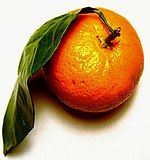
A tangerine
-

Tangerine or Narangi fruit during winters in Delhi
-

Narangi tree in Mohali
-

Narangi fruit
Nutrition [edit]
 A Murcott, probable a tangerine hybrid | |
| Nutritional value per 100 thousand (iii.5 oz) | |
|---|---|
| Free energy | 223 kJ (53 kcal) |
| Carbohydrates | 13.34 g |
| Sugars | x.58 g |
| Dietary fiber | 1.viii k |
| Fat | 0.31 g |
| Protein | 0.81 g |
| Vitamins | Quantity %DV † |
| Vitamin A equiv. beta-Carotene | 4% 34 μg1% 155 μg |
| Thiamine (B1) | 5% 0.058 mg |
| Riboflavin (B2) | 3% 0.036 mg |
| Niacin (Biii) | three% 0.376 mg |
| Pantothenic acid (B5) | 4% 0.216 mg |
| Vitamin B6 | 6% 0.078 mg |
| Folate (B9) | 4% 16 μg |
| Choline | 2% ten.2 mg |
| Vitamin C | 32% 26.seven mg |
| Vitamin E | 1% 0.two mg |
| Minerals | Quantity %DV † |
| Calcium | 4% 37 mg |
| Iron | ane% 0.fifteen mg |
| Magnesium | 3% 12 mg |
| Manganese | two% 0.039 mg |
| Phosphorus | 3% 20 mg |
| Potassium | four% 166 mg |
| Sodium | 0% 2 mg |
| Zinc | i% 0.07 mg |
| Other constituents | Quantity |
| Water | 85.2 g |
| Link to USDA Database entry | |
| |
| †Percentages are roughly approximated using US recommendations for adults. Source: USDA FoodData Primal | |
Tangerines contain 85% water, xiii% carbohydrates, and negligible amounts of fat and protein (table). Among micronutrients, merely vitamin C is in meaning content (32% of the Daily Value) in a 100-gram (3.5 oz) reference serving, with all other nutrients in low amounts.
References [edit]
- ^ "Citrus tangerina Yu.Tanaka — The Institute Listing". theplantlist.org.
- ^ Mandal, Shyamapada; Mandal, Manisha (2016). "Tangerine (Citrus reticulata L. Var.) Oils". Essential Oils in Food Preservation, Flavor and Safety. pp. 803–811. doi:ten.1016/B978-0-12-416641-7.00091-ii. ISBN978-0-12-416641-vii.
- ^ "Citrus deliciosa Ten.". Plants of the Globe Online. Royal Botanic Gardens, Kew. Retrieved 10 June 2021.
- ^ "Dwelling house : Oxford English Dictionary". oed.com.
- ^ Froelicher, Yann; Mouhaya, Wafa; Bassene, Jean-Baptiste; Costantino, Gilles; Kamiri, Mourad; Luro, Francois; Morillon, Raphael; Ollitrault, Patrick (2011). "New universal mitochondrial PCR markers reveal new data on maternal citrus phylogeny". Tree Genetics. vii: 49–61. doi:10.1007/s11295-010-0314-x. S2CID 32371305.
- ^ Li, Xiaomeng; Xie, Rangjin; Lu, Zhenhua; Zhou, Zhiqin (2010). "The Origin of Cultivated Citrus as Inferred from Internal Transcribed Spacer and Chloroplast Deoxyribonucleic acid Sequence and Amplified Fragment Length Polymorphism Fingerprints". Periodical of the American Gild for Horticultural Science. 135 (iv): 341–350. doi:10.21273/JASHS.135.4.341.
- ^ a b Commernet, 2011. "twenty-thirteen.0061. Sunburst Tangerines; Classification and Standards, twenty-13. Market Classification, Maturity Standards And Processing Or Packing Restrictions For Hybrids, D20. Departmental, 20. Department of Citrus, Florida Administrative Lawmaking". State of Florida . Retrieved fourteen May 2015.
- ^ a b Larry K. Jackson & Stephen H. Futch. "HS178/CH073: Robinson Tangerine". Retrieved fourteen May 2015.
- ^ Pittman & Davis (22 February 1999). "Pittman & Davis – Premium Citrus Fruit Gifts – Why Are Tangerines And so Tangy?". Pittmandavis.com. Retrieved 17 Nov 2012.
- ^ David Karp (28 January 2011). "Market Picket: The wild and elusive Dancy". LA Times . Retrieved 19 July 2015.
- ^ See the Oxford English Dictionary, second edition, 1989.
- ^ "Crops/World regions/Production quantity (pick lists) of tangerines for 2019". Nutrient and Agriculture System of the United Nations, Statistical Division (FAOSTAT). 2020. Retrieved 3 March 2021.
- ^ H. Harold Hume (1913). Citrus Fruits and Their Culture. O. Judd Company. p. 101.
- ^ a b "dancy". world wide web.citrusvariety.ucr.edu . Retrieved two May 2018.
- ^ Wu, Guohong Albert; Terol, Javier; Ibanez, Victoria; López-García, Antonio; Pérez-Román, Estela; Borredá, Carles; Domingo, Concha; Tadeo, Francisco R; Carbonell-Caballero, Jose; Alonso, Roberto; Curk, Franck; Du, Dongliang; Ollitrault, Patrick; Roose, Mikeal 50. Roose; Dopazo, Joaquin; Gmitter Jr, Frederick G.; Rokhsar, Daniel; Talon, Manuel (2018). "Genomics of the origin and evolution of Citrus" (PDF). Nature. 554 (7692): 311–316. Bibcode:2018Natur.554..311W. doi:10.1038/nature25447. PMID 29414943. S2CID 205263645. and Supplement
- ^ Larry K. Jackson & Stephen H. Futch (half dozen June 2018). "HS169/CH074: Dancy Tangerine". ufl.edu.
- ^ "Satsuma cultivars: The all-time and the worst". AL.com. 30 Oct 2009. Retrieved 14 May 2015.
- ^ USA, Slow Food. "Dancy Tangerine". Slowfood U.s.a. . Retrieved 2 May 2018.
- ^ "HS174/CH078: Murcott (Dear Tangerine)". Edis.ifas.ufl.edu. Retrieved 17 November 2012.
- ^ "HS168/CH079: Sunburst Tangerine". Edis.ifas.ufl.edu. Retrieved 17 Nov 2012.
- ^ Larry Thou. Jackson & Stephen H. Futch. "HS173/CH075: Fallglo Tangerine". Retrieved xiv May 2015.
External links [edit]
Source: https://en.wikipedia.org/wiki/Tangerine
0 Response to "You Will Not Buy Tangerines Again"
Post a Comment